



“What’s motivated you in your current role? What’s made you stay there for nearly ten years?”
It’s 2014, and I’m having a conversation with a search firm about a new job. It’s for a global coffee company, and on paper it ticks all the right boxes: promotion, better title, more money, five minutes from my house, won’t take half an hour to explain to my Mum.
But now, thinking about my answer to this question, something doesn’t feel right…
“What is it you like about your current job?” the interviewer asks again.
I start to talk about what has motivated me at Heathrow for nearly a decade: “I’ve always wanted to do jobs that have a real impact, something where you can make a difference - not a job where I’m just… just…”
My words trail off.
“Selling more cups of coffee?” the headhunter ventures.
I shift uncomfortably in my seat. I suddenly have a vision in my head of that famous First World War poster: “Daddy, what did you do in the Great War?” only there’s a thought bubble coming from the man in the armchair and it’s got a takeaway coffee cup inside.

Is this really how I want to spend my career?
“You know, this company really does believe they are changing the world one cup of coffee at a time.”
And that was the moment I realised: purpose matters to me.
The purpose backlash
“Purpose” was all the rage in the 2010s. But like most management doctrines its moment came and went. Overuse, changed politics, and a tougher economic environment has seen something of a backlash against companies talking about “purpose”.
That’s a shame. Most people want to do something more meaningful with their lives than just be paid for their labour. The most successful and sustainable companies offer a deeper vision and set of values. And most of all, I think personal purpose can be a useful way for individuals to identify which jobs will be most suited to them.
At the high point of purpose-driven leadership, the concept of ikigai became popular. It is a Japanese word made up of two parts: “iki” means “life”, and “gai” is “worth living”.
Héctor García, the author who popularised it, interviewed people in a village in Okinawa renowned for the longevity of its residents.
“When we asked what their ikigai was, they gave us explicit answers, such as their friends, gardening, and art. Everyone knows what the source of their zest for life is, and is busily engaged in it every day,” he reported.
Human beings have always been obsessed with the secret to immortality. That quest was given a boost by the discovery of ‘blue zones’. These were five small regions around the world where people seemed to live extraordinarily long lives full of vim and vigour. This was attributed to everything from Mediterranean diets to, in Okinawa, ikigai.
The only problem is… many of these reasons might not be true.
In 2024 a researcher called Saul Newman, found some other things these areas with very long life expectancy had in common: unreliable birth records 100 years ago; higher rates of pension fraud, including dead relatives being kept on the books to collect benefits; and a surprisingly high ratio of centenarians to 90 year-olds.
So should we junk ikigai?…
I think not. Perhaps it won’t get you to 100. But I have found some of the frameworks that evolved from the idea to be useful tools when thinking about job choices.
Ikigai as a test of job fit
After watching a TED Talk called “How to live to be 100”, Marc Winn created a Venn diagram to illustrate the concept of ikigai. He suggested that it sits at the intersection of what you love, what you’re good at, what the world needs, and what you can be paid for.
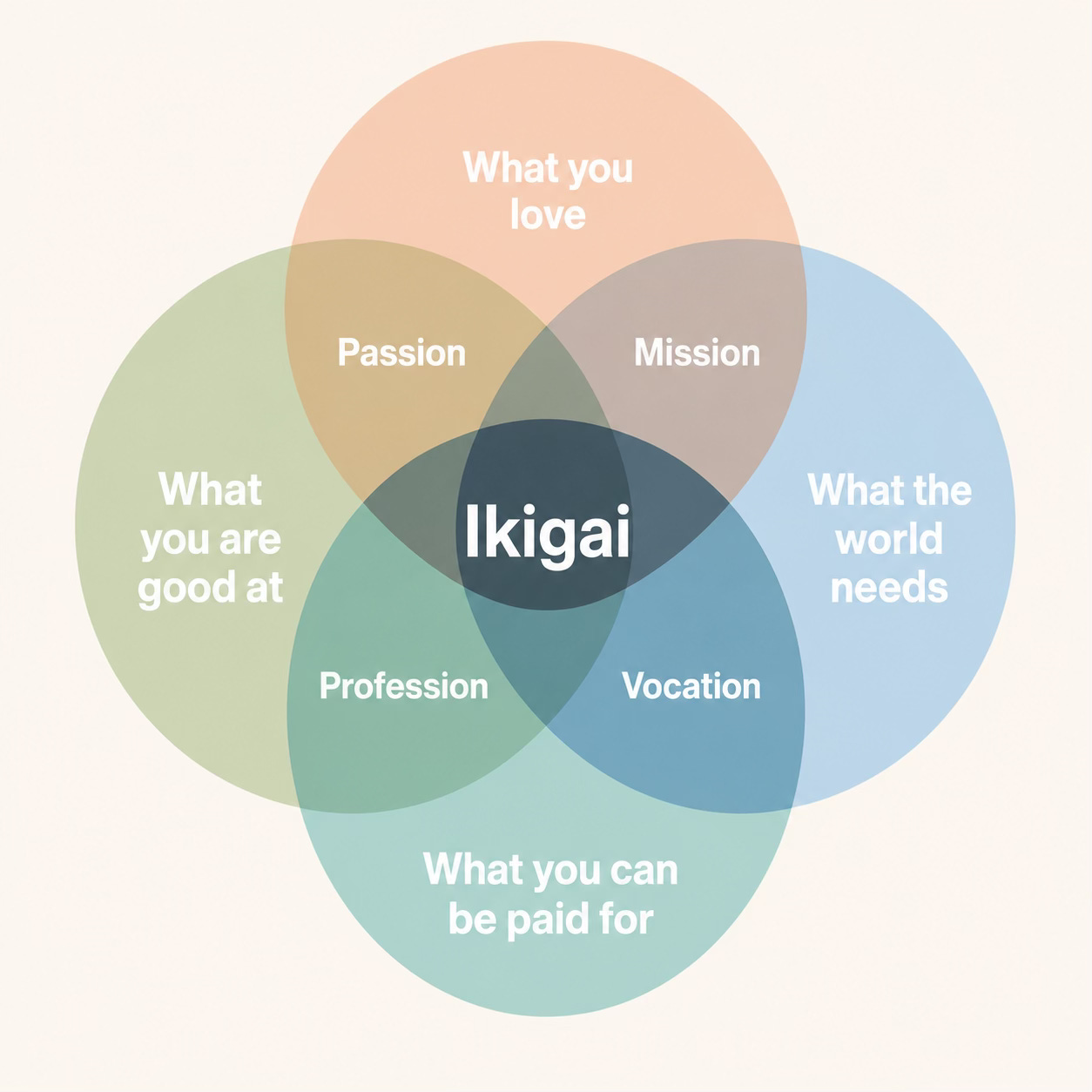
One criticism is that this creates unrealistic expectations of what you’re going to get from your job alone. That feels fair. No job is going to deliver total life fulfilment. But as a framework for your whole life - professional and personal - it feels valuable. And for me, it becomes more useful still when you stop treating it as a search for fulfilment and think of it as a test of job fit.
Senior communications roles are rarely easy. They involve ambiguity, conflict, pace, judgement and stress. They can be intellectually and emotionally draining. You are often paid to sit close to anxiety: a nervous chief executive, an angry workforce, a hostile journalist, a board that wants certainty where none exists.
In those moments, your resilience can be helped by having chosen the right role in the first place - one which is worth the strain.
I think Marc Winn’s ikigai framework is a pretty good tool for identifying what kind of work is going to give you energy, be worth periods of strain, and be a good fit for your skills?
Here are four useful tests:
The first test is energy - doing what you love. Doing what you love is a more practical test than it might seem. Which parts of the job leave you on a high, and which leave you depleted? Some people are energised by crisis. Others are better in relationship-led roles. There is no virtue in pretending to enjoy work that in reality drains you. A crisis role may sound impressive, but if every incident empties the tank, it is unlikely to be sustainable.
The second test is usefulness - doing what you’re good at. Where can you make the biggest difference? This is where you need honesty - from those around you, but most importantly with yourself. Wanting to be good at something, is not the same as being good at it. For communicators, strengths might be simplifying complexity, building trust, spotting risk early, or helping leaders find the right words. Most critically, what are you good at that others find difficult? That’s where your strengths can become a commercial asset.
The third test is value - doing what the world needs. What does the organisation need and does that matter to you? Some need reputation repair. Some need a stronger internal culture. Some need to win an argument with government, regulators or the public. If you can identify what motivates you and match it with what a company really needs then that’s likely to be a great fit.
The fourth test is sustainability - doing what you can be paid for. Can you keep doing this without becoming resentful, cynical or exhausted? I would widen this beyond money to status, workload, family life, health and values. You can sometimes ignore these short-term, but they might be the conditions that decide whether a role can be carried over time.
If the answers to these four tests are weak, the warning signs usually appear as boredom, fatigue, cynicism or a growing sense of misfit. You may have a good title. You may be paid well. But the work has stopped giving back enough to justify what it takes out. It can be difficult to be honest about whether you have become addicted to some things - maybe money, status or the adrenaline of a crisis - while ignoring others that matter to you for longer than is healthy.
If the answers are clear, purpose can be a real source of stamina. You can not only absorb pressure but thrive in it because you understand the role you are playing, feel it matters, enjoy it and are valued and recognised by others.
You will probably spend somewhere between 70-90,000 hours of your life in work. If you can find something that draws on what you enjoy, uses what you are good at, pays enough to be sustainable, and solves a problem you believe is worth solving, you are more likely to build a career that gives as much back as it takes out.
Part 1 of this series on communications leadership under pressure is here:


