

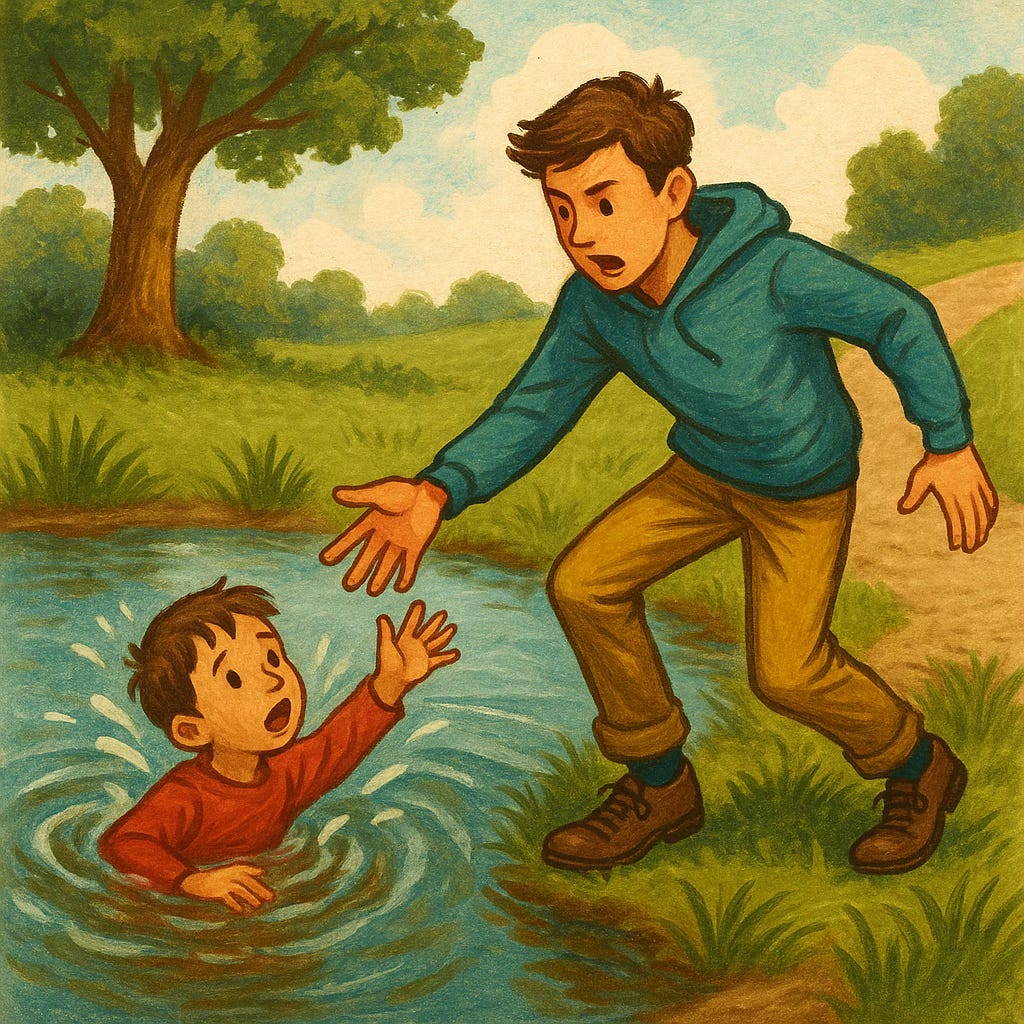
The philosopher Peter Singer developed a thought experiment for his students.
“Imagine your route to university takes you past a shallow pond”, he said.
“One morning, you notice that a child has fallen into the pond and appears to be drowning. You could easily wade in and save them, but if you do then your clothes will get muddy. Your shoes will almost certainly be ruined.
“Should you save the child?”
Unsurprisingly, the response of his students was unanimous:
“Are you insane?! Of course you should save them. The cost of replacing your shoes shouldn’t even be a consideration!”
“Okay”, said Peter. “Now imagine another scenario”:
“You’re going shopping to buy a new pair of shoes. But the money you spend could save the life of a child if you donated it to a charity to provide life-saving medicine.
“Is your moral obligation any less just because the child is farther away?
“Isn’t saving their life more important than buying a new pair of shoes?”
The experiment is designed to raise questions about ethics and moral responsibility.
But it also reveals something fundamental about how we process information, and why some communication fails.
We are not rational beings
Proximity, emotion, and the vividness of seeing something happening to a real person carry far more weight in our minds than facts, data or abstract reasoning.
We are moved more by a single identifiable victim than by millions of anonymous deaths.
We like to think of ourselves as rational beings. Being “emotional” can even be a term of abuse.
Yet, the truth is that human beings are not rational calculators weighing up the pros and cons of each option.
We rely on mental shortcuts, also known as heuristics. These let us make decisions quickly with minimal effort, but they also introduce predictable biases.
For communicators, if you want people to act you should design messages that work in tandem with these fundamentals of human psychology.
How our brains filter and construct reality
The development of heuristics probably gave our ancestors a survival advantage.
The human brain is bombarded with more sensory information than it can possibly process consciously. We receive signals from our eyes, ears, skin, nose, taste buds, muscles and internal organs. The raw firehose of data from our eyes alone might be as much as 10 million bits per second. Contrast this with estimates for the conscious processing power of our mind: just 40-60 bits per second.
So our brain relies heavily on filters, short-cuts and habits.
In fact, we don’t see ‘reality’ at all. We see a filtered, constructed version that is optimised for our conscious mind to take action.
If you want a quick example then flick your eyes from left to right or vice versa. You should see a blur of motion. But you don’t. The brain edits it out in real time. Although you may never have noticed it, your vision is briefly suppressed between those two points of focus. Your eyes are still sending your brain a flood of visual data, but the brain skips the messy frames to stitch together a neat and stable picture.1
You don’t see reality, you see the edited highlights.
Even more incredibly, the brain doesn’t just filter things out, it adds them in.
Each eye has a natural blind spot where your optic nerve connects to your retina. No photoreceptors exist there, meaning no data at all is reaching your brain. But you don’t see a black hole floating around. Your brain fills in the gap using the surrounding detail and pattern.2 You literally see something that isn’t there.
Our brains are built to prioritise certain sensory threats, opportunities and patterns that mattered most for survival.
These usually serve us well even today, but they also create predictable biases that should be understood by communicators.
Some of our predictable biases
Salience and contrast. We are drawn to what stands out from the background such as bright colours, unusual shapes or hard edges. This once helped us to spot fruit or predators in the undergrowth, today communicators exploit it through high-contrast visuals or bold design. (See the Cut Through! logo!)
Face detection. This was vital for a social species. Being able to identify expressions of anger, fear or joy in a fraction of a second helped us to cooperate with allies and avoid threats. We have a specialised neural network3 for detecting faces and we see them even where they do not exist, such as in clouds, plug sockets, even burnt toast. Faces in communication capture attention immediately and trigger emotional responses.
Gestalt grouping. Our brains assume patterns and complete missing information. We group objects that are close, similar in shape and size or moving in the same direction together. Historically, this helped us to identify a herd rather than individual shapes and allowed for faster decisions. Today, logos and infographics exploit rules of grouping. Look at the IBM logo for example - a series of lines that we group into three letters.
Emotional vividness. We prioritise stimuli that were most relevant to our survival such as children, animals or visceral danger. The cost of over-reacting to a rustle in the bushes or a twig snapping was low compared to the cost of missing a predator and that bias still drives our attention today.
So what?
You might imagine that human traits like these are becoming less relevant as we move further from the environment in which they evolved. But you would be completely wrong.
The algorithmic social media environment we operate in rewards exactly these features.
Using and understanding behavioural science in communications matters not just because it is how humans are hardwired to respond, but also because it is what social media algorithms have learned to exploit.
In a low-trust, high-speed media market the competition for attention is being won by those communicators who know how to harness these dynamics.
If attention is scarce, then design your communication to work with the grain of human perception, not against it. If our brains work on shortcuts then design your strategy for them.
Communications such as dense government statistical reports or evidence-based policy arguments are important but won’t be how most people make a decision. Communicators need to design messages that work intuitively first, then back them up with rational evidence.
Communicators who use the principles well, can cut through, build loyalty and change behaviour. For example, encouraging people to eat more fruit and vegetables with “Five-a-day” was an example of communicators creating an intuitive mental shortcut to make it easier for people to make healthier choices.
Next week, I’m going to rank the top ten behavioural science techniques that I think can give communicators an advantage - such as loss aversion, social proof, anchoring, authority bias, and nudge.
And in future I’ll share some practical tools that make it easy to incorporate these into your communication.
Let me know which elements of behavioural science you’re interested in and would like me to write about by leaving a comment below.
Until then, thanks for reading or listening, and please do subscribe if you haven’t already, and share with other communicators who want to cut through the noise!
Simon
Deep cuts:
Singer, P. (2017) The Drowning Child and the Expanding Circle
1 This is known as saccadic masking - https://en.wikipedia.org/wiki/Saccadic_masking
2 This first documented discovery of this phenomenon was by Edme Mariotte in the 1660s - https://en.wikipedia.org/wiki/Blind_spot_(vision)
3 This is known as the fusiform face area or FFA - https://en.wikipedia.org/wiki/Fusiform_face_area


