



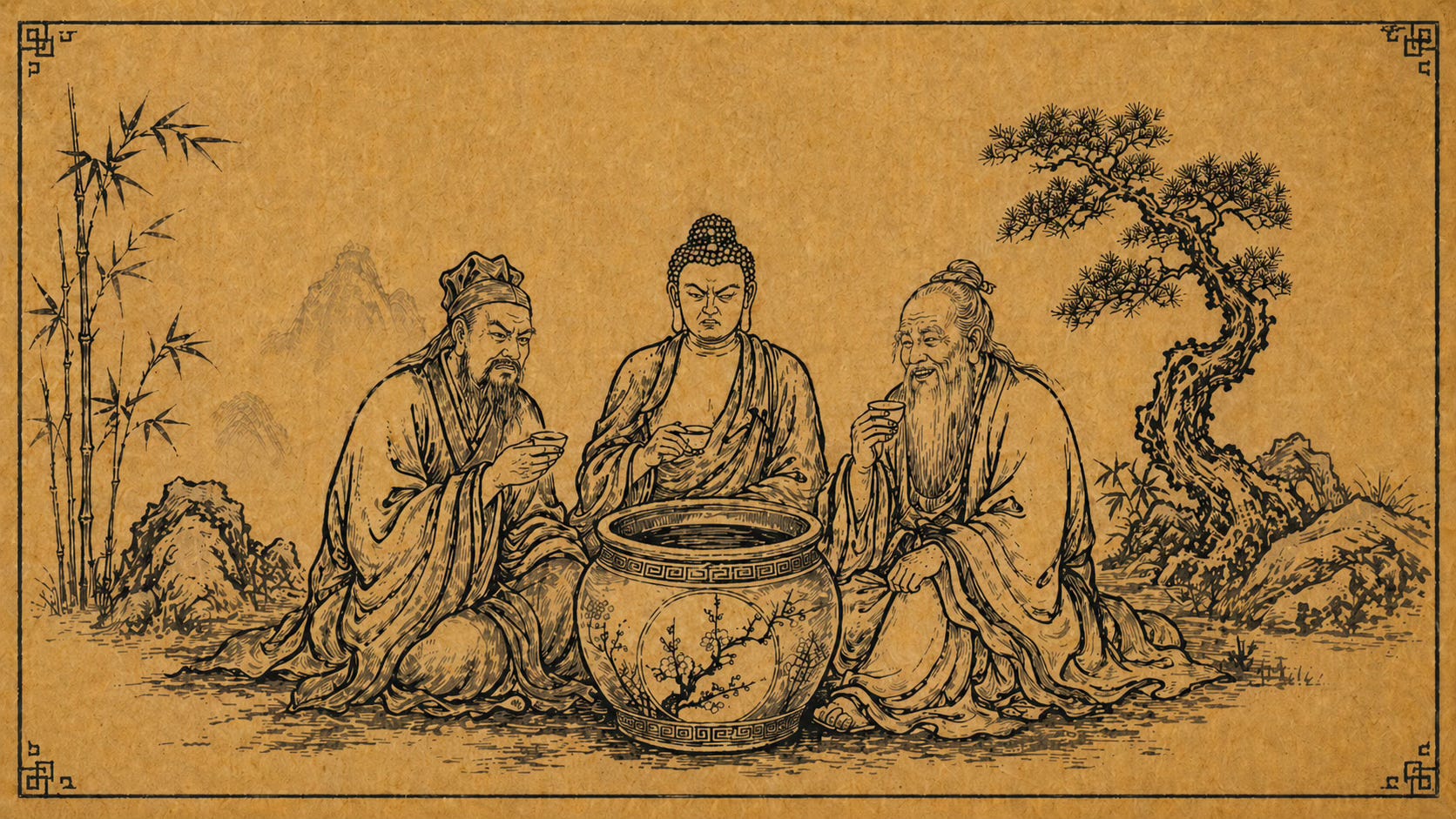
There is an image in Chinese painting called The Vinegar Tasters.
Three figures sip from a vat of vinegar. Each represents a branch of Eastern philosophy.
Confucius tastes the vinegar and scowls. Life is sour and needs rules and order.
The Buddha tastes the vinegar and grimaces. Life is bitter suffering to be withstood and transcended.
Laozi, the Daoist, tastes the vinegar and smiles. He accepts the world as it is and it tastes sweet.
Same vinegar. Different approach to seeing the world. Different reaction. The point of the image is that the same reality can be experienced differently depending on the frame we bring to it.
Resilience is about interpretation, not endurance
One of the most common questions people ask about my time in government is “How did you manage your resilience?” Their perception is that the pressure must have been overwhelming. That wasn’t my experience overall.
But there were times, especially early in my career, where pressure affected me mentally and even physically. During one crisis at Heathrow in 2010, I worked 36 hours straight. This included a crazy early morning phone call to American Airlines in Dallas trying to get them to divert aircraft. (Generally speaking, when the comms guy is doing that, you know something has gone very wrong with your crisis ops). Afterwards, I found myself having physical heart palpitations for about three months.
It was the moment I realised that I either needed to take resilience more seriously or I was in danger of limiting the types of jobs I could do in my career. That same week, there was an episode of BBC’s In Our Time on Daoism. It inspired some ways of thinking that I feel have helped me be more resilient. I’m going to cover these in separate articles over the coming months.
Today, I want to start with this idea: that resilience is not about withstanding stress but about learning how to maintain perspective and balance. The same event can produce different emotional reactions depending on the meaning we attach to it. And we can improve our resilience by learning to pause, examine that meaning, and actively choose a more useful response.
We do not simply see reality, we interpret it.
The first step is to accept that, like The Vinegar Tasters, we do not simply experience events. Our experience is built on our framing and our interpretation.
For example, we know two people can see exactly the same image differently. The duck-rabbit drawing below was first used by American psychologist Joseph Jastrow more than 100 years ago to make the point that perception is not just what we see. If some of us see a duck and some see a rabbit, our brains must be interpreting the signals they receive.
In fact, as I set out in this piece, our brains rely heavily on short-cuts. We see a filtered, constructed version of reality.
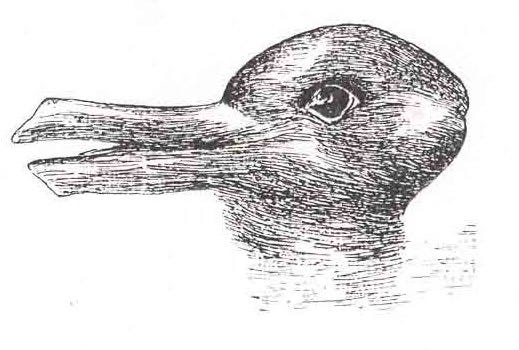
This matters, because if the same event causes us to see different things, then it is likely we will think and feel different things too.
For example: imagine that someone you know walks past you in the street and blanks you.
One reaction is to assume you have offended that person. You might worry about what it was you did. You might feel anxious or even have a physical reaction, like feeling sick. Perhaps you avoid the person as a result.
But an alternative reaction is to think the person seems preoccupied. You might wonder if they are having a bad day. You might feel concern for the other person and decide to seek them out and check up on them later.
Both are experiences of the same event, but the emotion, feeling and action is driven by the meaning attached to it.
You can choose your response
Viktor Frankl was an Austrian psychiatrist born into a Jewish family in Vienna at the start of the 20th century. He took psychology night classes while at high school, and corresponded with Sigmund Freud while still a teenager.
In 1942, he and his family were sent to the Theresienstadt concentration camp, where his father died of starvation and pneumonia. In 1944, he and his surviving relatives were transported to Auschwitz where his mother and brother were murdered in the gas chambers. His wife died in Bergen-Belsen.
After the war, Frankl wrote about his experiences in the book “Man’s Search for Meaning.” Everything had been stripped away in the camps: possessions, status, privacy, safety, family, health and of course often life itself. Yet, Frankl said this:
“Everything can be taken from a man but one thing: the last of the human freedoms: to choose one’s attitude in any given set of circumstances, to choose one’s own way.” - Viktor Frankl, Man’s Search for Meaning.
I find this an astonishingly powerful idea. That even in the darkest moment, in the most barbarous example of mankind’s capacity for inhumanity, people still retain some choice and freedom. When almost every action is impossible, a person retains some choice in how they respond: with bitterness, or dignity, or faith, or care for others, or moral purpose.
There is another quote often attributed to Frankl. I am not sure it is actually his, but it captures his philosophy well:
“Between stimulus and response there is a space. In that space is our power to choose our response.”
Nothing in ordinary professional life can be compared with the camps. But I think the darkness of its gestation shows the power of Frankl’s idea. If he could retain any inner freedom in those circumstances, then most of us have so much more room to choose our response than we admit.
The power of his idea also lies in the fact that it can be practiced. Once you recognise there is a moment between what happens to you and how you respond, it can be transformational. You can make that moment longer. You start to recognise that what happens next is not only shaped by what has happened to you, but by the meaning you give to it.
Your personal story can help or harm you
The response we choose is often shaped by the story we tell ourselves about what has happened and what it means.
We each have our own story about ourselves and who we are. What we’re good at and what we’re not, what we like doing and what we don’t, how we made it or why we didn’t.
We stay attached to those stories, and they start to be more than just reflections of ourselves. They start to influence what we do and the choices we make. Sometimes we recognise that those stories limit us. Perhaps we think we shouldn’t be in this room with all these senior people, and so we don’t speak up when we should.
But here is the key point: we have some choice in our interpretation.
Just as we can choose our response, we can choose the story we tell ourselves more intentionally too. We can make it something we consciously curate, rather than allowing the first version our mind supplies to become the only version available. You can make your story more helpful to you.
Ancient and modern wisdom say the same thing
This idea doesn’t just appear in Daoist philosophy or from Frankl. Marcus Aurelius was a Roman Emperor in the second century AD and one of the best known Stoic writers. In his book, Meditations, he advocates a similar idea - that it is not the nature of events themselves that disturb us so much as the judgements we make about them.
“If you are distressed by anything external, the pain is not due to the thing itself, but to your estimate of it; and this you have the power to revoke at any moment.” Marcus Aurelius, Meditations.
This is not a call to be indifferent or uncaring. Neither is it an invitation to ignore difficult evidence or resist negative feedback. In fact, it’s the opposite. It is about having the power to assess such evidence dispassionately and disconnect it from personal emotion.
Stoicism also advocates separating what you cannot control (such as bad things happening) from what you can control (the judgements you form and the story you tell yourself). This is a particularly important lesson for leaders whose predisposition is to fix things by working harder or being across more of the detail. Why was I calling American Airlines to divert that flight at 1am? Because it needed fixing and no-one else was doing it. But I couldn't fix it. Sometimes resilience comes from having the wisdom to recognise what you cannot control.
Modern psychology arrives at a similar place through Cognitive Behavioural Therapy. It is also based on the insight that emotions are not just shaped by events, but by the thoughts and beliefs we bring to those events. It does not deny reality, but asks us to think about whether our interpretation is accurate or useful.
Putting it into practice
Being able to project calm and think clearly, even in a volatile or chaotic situation, is part of leadership. Nobody wants to follow someone running in the office during a crisis. But projecting calm in a crisis is difficult and takes technique and practice.
The hardest part is that these techniques are most difficult to employ when you need them most. When a crisis hits your first response is often automatic and your body reacts before your conscious mind has caught up.
Here are five steps to practise:
First, look for the physical signals. Am I breathing quickly or clenching my jaw? Do I feel a tightening in my stomach? Am I rushing? Am I experiencing tunnel vision and narrowing choices too quickly?
Second, call out the story that you are telling yourself. What am I assuming this means? For example, have I started to think: “this whole thing is failing”. Articulating this out loud or writing it down might feel like a luxury you don’t have in a crisis, but it is useful because it turns your automatic reaction into something you can examine.
Third, separate fact from interpretation. Ask yourself what you know for certain, what you have added, and what else could be true.
Fourth, choose the most useful frame. This isn’t about being wildly optimistic. It is about choosing a useful interpretation that is supported by the facts. For example, you might move from thinking “We’re screwed!”, to thinking “This is serious, but there are things we can do right now that will make it better. My job is to identify those and help people deliver them.”
Finally, decide the right next action. That might be to do something, but it could equally be to hand over to someone else and sleep for a few hours, or to accept that something is outside your control.
So, in that space between stimulus and response, the practical questions are:
What am I feeling?
What is the story I am telling myself about this?
What are the facts, and what is my interpretation?
Is there a more helpful way to frame it?
What is the right next action?
I wish I had understood this better in 2010. I might have been able to see the situation differently: not as a personal responsibility to fix everything, but as a crisis in which my job was to think clearly and focus on the communications needed to help the system recover.
This is simpler to describe than to do. I wouldn’t claim to have mastered it. But by practising these techniques I do think I have become calmer during my career, even as the pressure of situations has grown.
I now recognise that the way I choose to respond and the way I describe the situation to myself really does have an element of choice. And that choice has a very real impact not just on how I feel but on how well I lead.
Deeper Cuts
If you’d like to know more about Stoic leadership then I recommend this excellent article by Ghassan Karian from Is it working? I was also delighted to see that the ancient Stoics did pre-mortems.


