



Why does communication feel so difficult today?
The central argument of Cut Through! is that it is because our information environment has changed more quickly than our communications practice.
The world we are trying to communicate in is no longer the one most of our tools or instincts were designed for.
To catch up, we need to understand what has changed and why. Only then can we redesign our communication practice to fit this modern world.
Too often, the attempts we do make to respond to change are tactical or incremental. We experiment with a new platform or content format, or we add another channel to the mix.
We rarely take a step back and take a bird’s-eye view of the fundamental shifts that have rewired how information is found, created, distributed and consumed.
This series attempts to do that. Over the coming weeks, I’ll explore five structural changes to our information environment that together explain why modern communications feels harder than it used to:
The five big changes to our information environment
1. Democratisation. All knowledge has become available to everyone instantly. Traditional information gatekeepers have been swept away and almost anyone can discover, access and publish anything.
2. Fragmentation. As content has become more tailored and personalised our shared reality has splintered, weakening our ability to forge consensus, even on basic facts.
3. Abundance. The cost of producing and distributing content has fallen to almost zero. As a result, the volume of content has exploded and attention has become the scarce resource.
4. Corrosion. Misinformation travels as easily as truth. The quality thresholds for what gets published have radically lowered. Trust has reduced and credibility has become harder to establish.
5. Concentration. Paradoxically, while information has proliferated, visibility has become dependent on algorithms controlled by a small number of tech companies.
Over the next four weeks, I’m going to explore these transformational forces through the stories of four technological breakthroughs that reshaped our world: Google Search; the iPhone; the Facebook News Feed; and AI.
Why is Communications so difficult today? Pt 1: The Wizards of Menlo Park
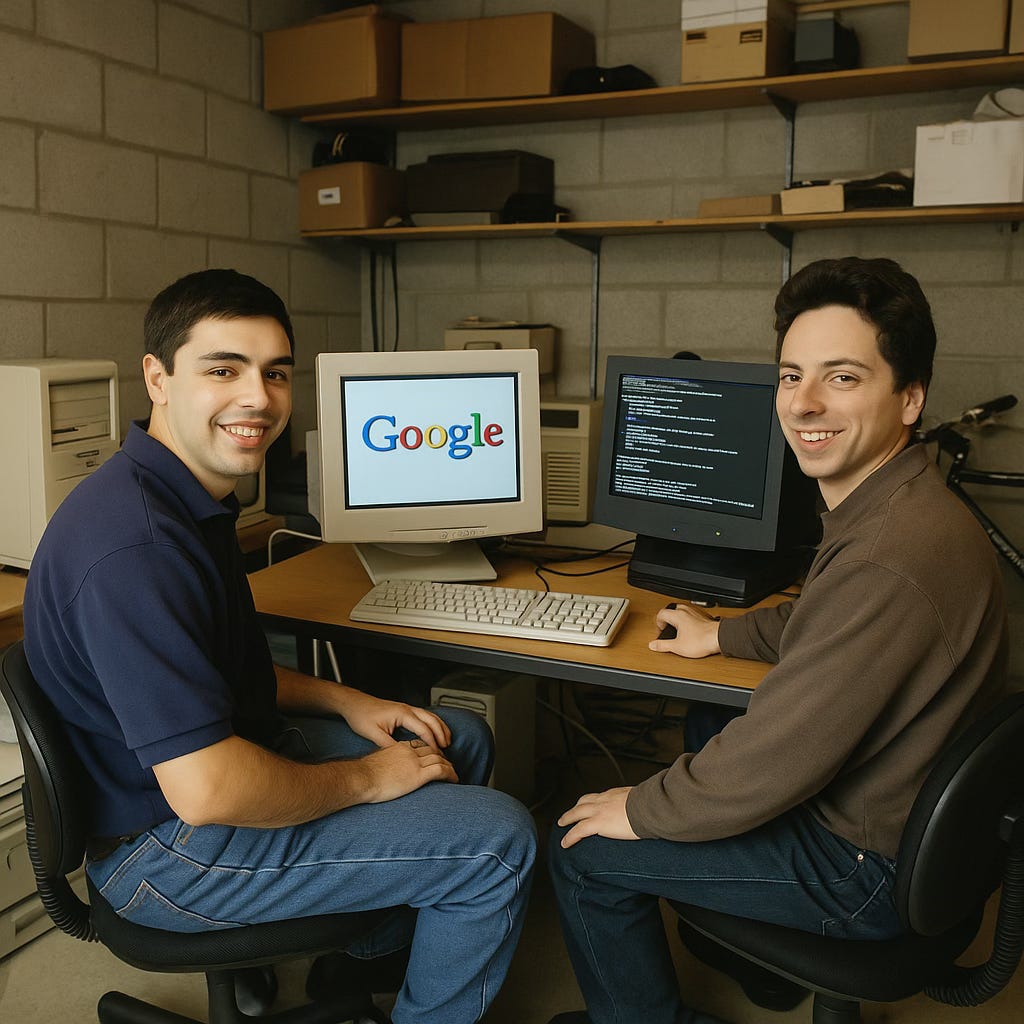
It’s 1995. A Stanford University student is working through potential topics for his doctoral thesis. He realises that the links connecting web pages might signify something about the quality of the page itself. After all, in academic publishing, aren’t papers with more citations considered to be better?
He creates a system, which he calls ‘BackRub’, that makes it possible to see who is linking to any given webpage. In total, in these early days of the internet, there are around 100 million links.
By the time he has indexed the entire internet, counted the links, and scored the quality of each page, the maths have become really complicated. So, he enlists a friend who is another Stanford post-grad and a prodigious mathematician.
Together, they create an algorithm called PageRank which ranks websites not by what they say about themselves, but by who else is pointing to them.
As they refine the program they realise it works for searching the internet. Its results are far superior to Lycos, Yahoo!, AltaVista or any of the other existing search engines.
They decide that BackRub possibly isn’t the best name for their new company, so ‘to backrub’ never becomes a verb.
Instead, Larry Page and Sergey Brin set themselves up in a garage in Menlo Park, California and name their company after the mathematical term for the number 1 followed by 100 zeros - a googol.
‘To Google’ does become a verb. And Google becomes the most successful company of all time.
Building a modern Tower of Babel
Up to this point, throughout human history, information had been curated by ‘experts’.
Religious leaders decided which texts would bring you closer to God, and which would see you branded a heretic. Librarians decided what should be filed in the archives, and what should be open to the public view. Encyclopaedia editors decided who merited an entry and who did not. And in the 20th century, newspaper proprietors and media moguls decided what the public should read, watch and listen to.
That all came to an end with Larry Page and Sergey Brin’s invention.
The creation of an easily searchable World Wide Web meant that for the first time all knowledge was available to everyone instantly. With a PC and a dial-up connection you could now find whatever you wanted, whenever you wanted.
Institutions no longer decided what information was news.
Unlike other search engines, there were no editorial choices on Google’s homepage. Just a logo and a blank box. People decided for themselves what they wanted to know about. News moved from being an editor’s judgement to what people chose to search for.
It was a moment as significant for human communication as Gutenberg’s printing press or Marconi’s radio. The hierarchy of information collapsed.
The consequences for communicators
At first it felt like liberation. A world of new possibilities opened up. No more persuading sceptical journalists of the merits of my story. I could publish the information I wanted to communicate directly on my company’s website.
It seemed as though a new golden age of unmediated direct-to-consumer communication had begun.
But then we noticed that this new unfiltered access to audiences came with some caveats.
1. Visibility now depended on discovery.
Having a story was no longer enough. How would people find it?
In the old world visibility had been won by having access to editors. In the new world it was earned or denied by an algorithm. Having a good story and a relationship with a journalist was no longer enough. To be seen online your content had to be discoverable within a system that ranked information based on opaque data links rather than editorial judgement.
That started to change communicators’ jobs.
Relationships and storytelling still mattered, but they were no longer sufficient by themselves. To be found, you had to understand how technology worked. If you wanted to be visible, you needed someone in your team who knew about search engine optimisation, metadata, keywords, and search rankings.
2. Democracy came with some uncomfortable edges.
Search had truly democratised the information environment. And it turned out there was a sizeable number of people who held views - conspiracy theories, pseudoscience, prejudice - that had not made it past media gatekeepers previously.
Traditional gatekeepers might have restricted the quantity of information available, but they had also moderated the quality. For all the questionable standards of tabloid newspapers in the 1990s, it became clear that they had been better than a free-for-all.
As traditional media’s role diminished, authority became harder to establish and misinformation travelled more easily. People could find thousands of inaccurate stories about your products and services with relative ease and trying to correct every one was a Sisyphean task.
You might now be able to communicate directly with citizens, but your own messages competed with the entire searchable universe of human opinion.
3. Our information environment began to fragment.
Naturally, each of us used Google to search for the things we were most interested in. And so we each pulled different information from different sources. Without consciously deciding to do so, we began assembling our own personalised version of the world, one search at a time.
Search had democratised access to knowledge, but an unintended consequence was that it weakened shared exposure. Over time, that started to dissolve consensus. This new freedom to access information meant the beginning of the fragmentation of our information environment.
For communicators it was the first signal that the environment we were operating in was changing from one built around shared reference points to one where information needed to be tailored to different audiences.
Search was only the beginning
Next time: Smart phones and social media accelerate these trends, and communication turns from a contest for ideas to a contest for interruption…

This series is deliberately focussed on diagnosis rather than prescription. Before we can talk confidently about what a winning strategy looks like today, we need to be clear about the environment we operate in.
Once that picture is complete, I’ll write about the communication strategies that are proving effective in a world shaped by these changes.
Thank you very much for reading. Please subscribe for free if you haven’t done so already, and please share with other communicators who want to cut through the noise and lead with confidence.
Simon
Deep Cuts:
Levy, S. (2011) In the Plex, How Google Thinks, Works, and Shapes Our Lives.


