

The D-FACC Summary Guide
A practical resource for communications leaders

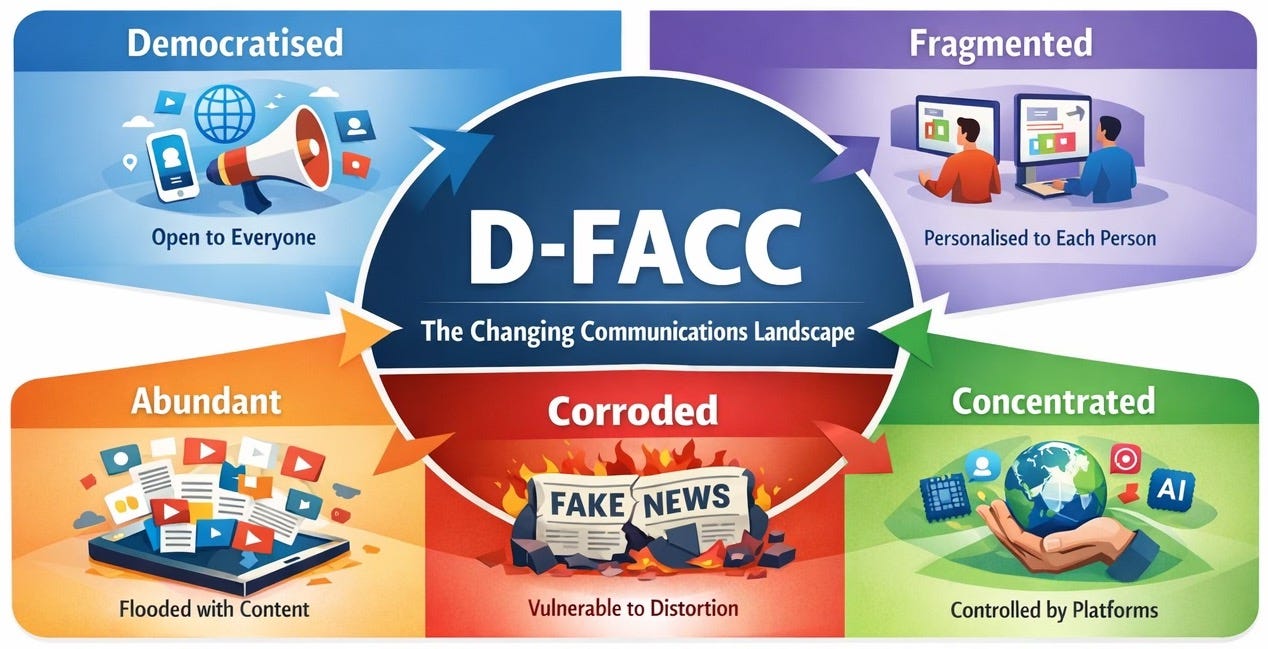
This toolkit distils my series on how our media and information environment has changed into a useful summary guide. You can use it as a strategy check, framing for boards, or a training lens for teams.
In a series on why communications feels harder today I’ve argued that our world has become more D-FACC:
Democratised
Fragmented
Abundant
Corroded
Concentrated
Together, these five shifts explain why the assumptions that communications was built on in the last century no longer hold.
1. D-FACC at a glance
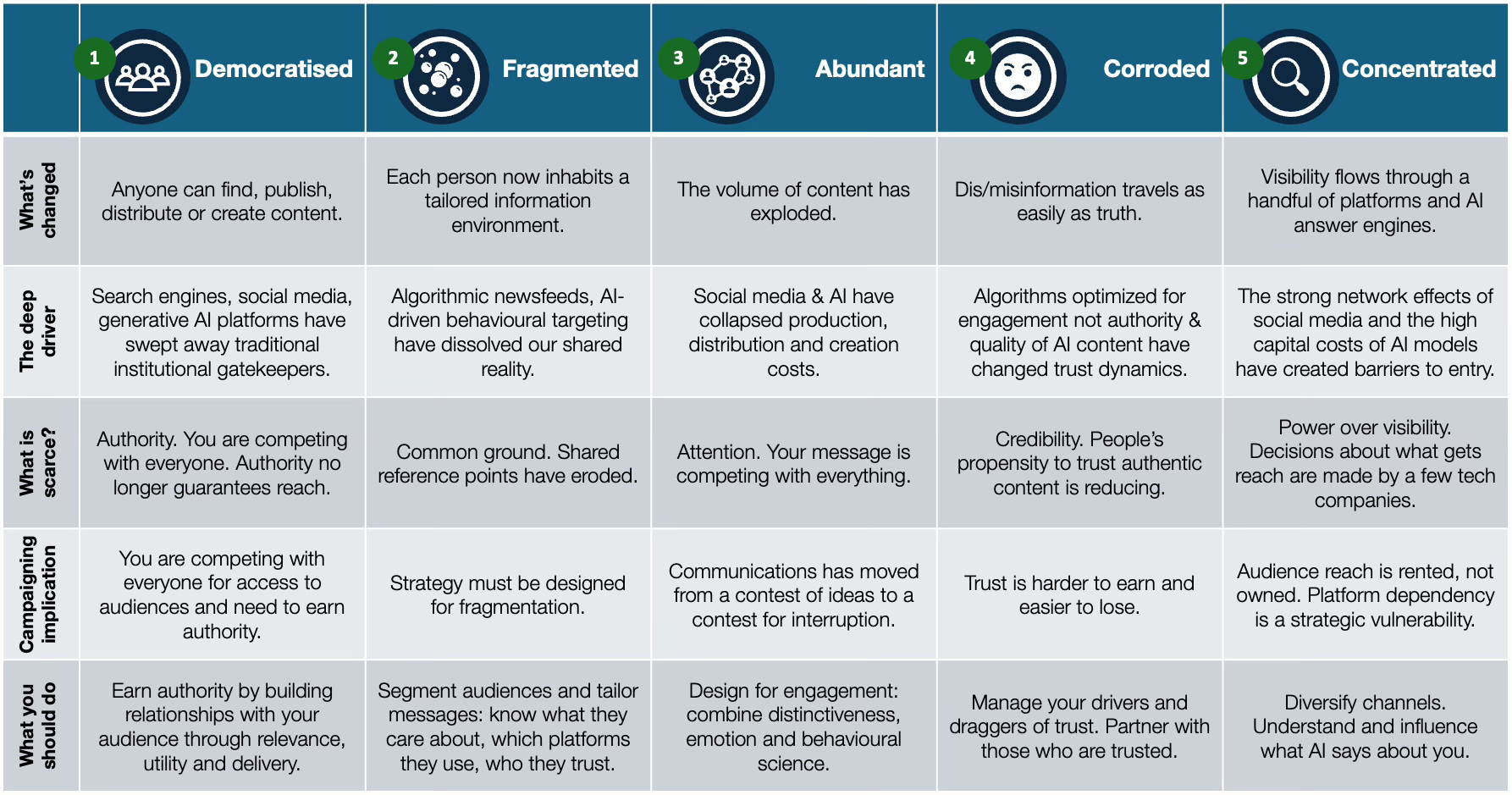
Democratised
What’s changed?
Anyone can find, publish, distribute or create content.
The deep driver
Search engines, social media, generative AI platforms have swept away traditional institutional gatekeepers.
What is now scarce?
Authority. You are competing with everyone. Authority no longer guarantees reach.
Leadership implication
You are competing with everyone for access to audiences and need to earn authority.
What you should do
Earn authority by building relationships with your audience through relevance, utility and delivery.
Fragmented
What’s changed?
Each person now inhabits a tailored information environment.
The deep driver
Algorithmic newsfeeds, smartphones, AI-driven behavioural targeting have dissolved our shared reality.
What is scarce?
Common ground. Shared reference points have eroded. Two people can experience the same issue, brand or leader through different narratives.
Leadership implication
Strategy must be designed for fragmentation.
What you should do
Segment audiences and tailor messages: know what they care about, which platforms they use, who they trust.
Abundant
What’s changed?
The volume of content has exploded.
The deep driver
Social media & AI have collapsed production, distribution and creation costs.
What is scarce?
Attention. Your message is competing with everything.
Leadership implication
Communications has moved from a contest of ideas to a contest for interruption.
What you should do
Design for engagement: combine distinctiveness, emotion and behavioural science.
Corroded
What’s changed?
Dis/misinformation travels as easily as truth.
The deep driver
Algorithms optimised for engagement not truth; Generative AI that makes falsehoods fluent and cheap.
What is scarce?
Credibility. People’s propensity to trust authentic information is reducing as falsehoods are becoming more convincing.
Leadership implication
Trust is harder to earn and easier to lose.
What you should do
Manage your drivers and draggers of trust. Partner with those who are trusted.
Concentrated
What’s changed?
Visibility flows through a handful of platforms and AI answer engines.
The deep driver
The strong network effects of social media platforms and the high capital costs of AI models have created barriers to entry.
What is scarce?
Power over visibility. Decisions about what gets reach are made by a few tech companies and their opaque algorithms.
Leadership implication
Audience reach is rented, not owned. Platform dependence is a strategic vulnerability.
What you should do
Diversify channels. Understand and influence what AI says about you.
2. The DFACC pressure test
A quick way to diagnose a communications challenge.
When something isn’t cutting through, ask:
Democratisation: Who else can say this now?
Fragmentation: Which audiences are we actually speaking to?
Abundance: Why would this beat everything else on their screen?
Corrosion: Why should anyone trust this?
Concentration: Which systems are mediating whether it’s even seen?
3. The DFACC memory card
The environment you’re operating in is now:
Democratised. Open to everyone
Fragmented. Personalised to individuals
Abundant. Flooded with content
Corroded. Vulnerable to distortion
Concentrated. Controlled by platforms
4. How to use this guide
As a diagnostic when work isn’t landing
As a framing for executives and boards about what needs to change
As a training lens for modern communications teams
As a strategy check before investing in channels, content or AI tools
5. D-FACC in full
You can read the full series on how our information environment has changed here:


