



A financial services company had a problem.
Its customer base was getting older each year because too few young people were using its services.
The answer?
“We need a comms campaign! If only more young people knew about us we’d have more of them as customers.”
And so the comms and marketing teams were put to work. They delivered a campaign and, as I believe the target audience might say, “it slayed”.
The result?
Nothing. No new customers. No obvious return on investment.
Why? Because the problem was not the awareness of the target audience. It was that they didn't have the money to invest in the first place, while the company didn't have a digital platform that matched how they managed their finances. The motivation to use the company’s services was already high, but the opportunity to use its services was limited.
Sometimes people decide communications is the answer without properly diagnosing the problem.
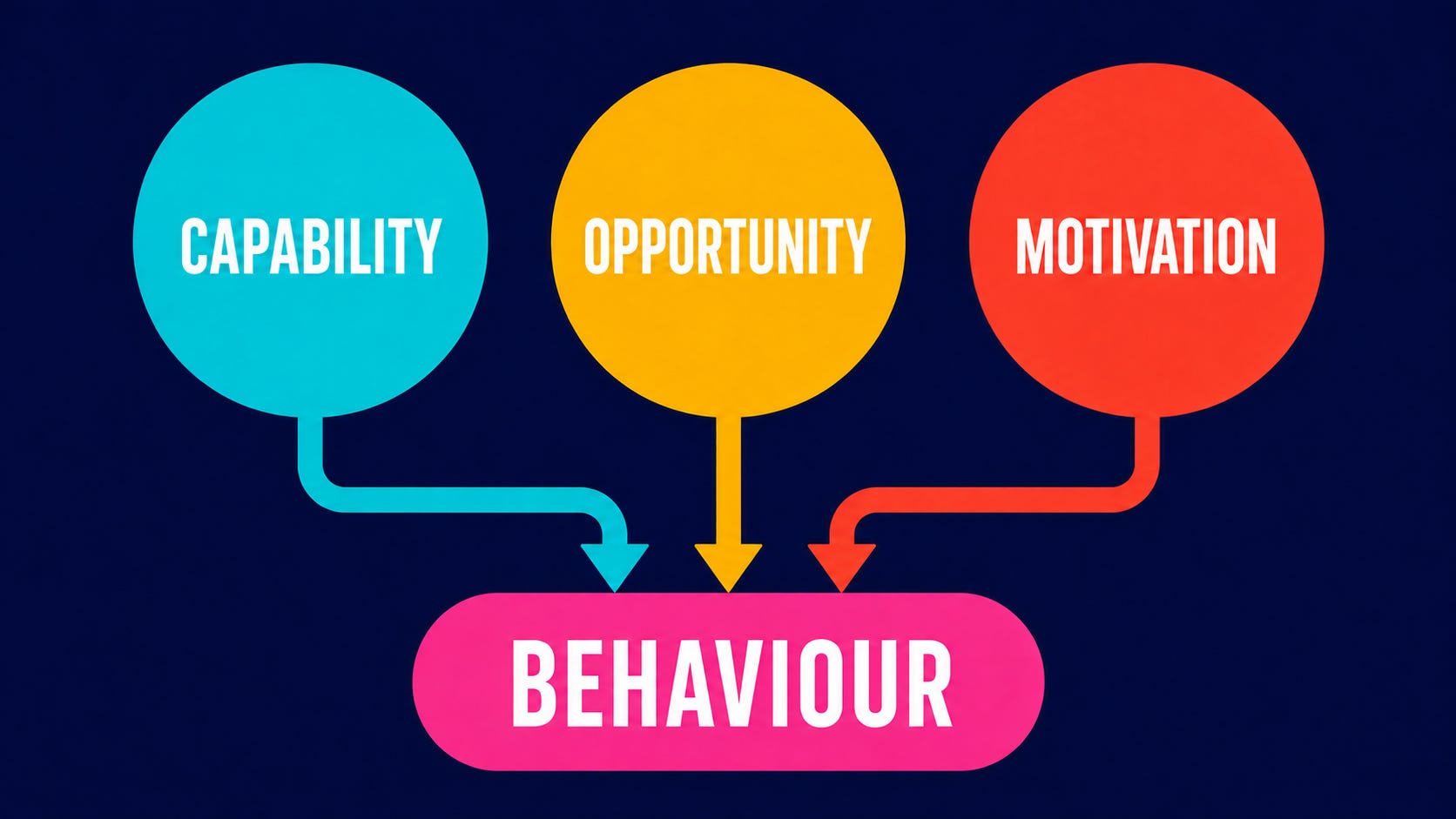
COM-B is a behaviour change approach that helps you identify the real barriers preventing your audience from taking action.
It stands for Capability + Opportunity + Motivation = Behaviour.
This article is about why it matters and how to use it.
Defining the precise behaviour and audience
Successful communications campaigns are generally trying to change behaviour. They might be encouraging someone to buy a product, apply for a job, adopt a healthier lifestyle, or adopt more favourable regulation. Reach, engagement, awareness, reputation can be important, but they are usually a means to an end.
The starting point for using COM-B is defining the outcomes that you are trying to achieve: what action from what audience. The trick here is to articulate as precise a behaviour as possible - a specific observable action you want to change. There are broadly five categories of change here. It could be encouraging someone to start a behaviour (attending an internal training course), stop a behaviour (quitting smoking), continue a behaviour (learning a language), change a behaviour (drinking less alcohol), or not take up a new behaviour (switching to a competitor).
Let’s take an example of a campaign I was responsible for when the UK was getting ready to leave the EU.
After Brexit, road hauliers travelling to and from Europe would face new checks and paperwork at the border. At first, our campaign defined the behaviour change required as a new responsibility for haulier drivers:
“drivers need to collect and check essential documentation from suppliers before setting off.”
Seems sensible, right?
But when our behavioural science team looked more closely, they realised we had got it wrong.
Interviews they conducted with drivers revealed that paperwork simply wasn’t seen as part of their job. That was for managers. Many drivers lacked the authority or language skills to have conversations about verifying paperwork. Some said they had chosen the job of driving precisely to avoid these types of interaction. Some even said they would rather carry the wrong documents, get stuck at the border, or avoid driving to the UK altogether rather than have a conversation about paperwork.
It turned out that the people we really needed to target were haulier managers. Their roles already involved dealing with the paperwork and making these types of decisions. Our instinctive focus, as civil servants based in Whitehall, had been on drivers. But that was because we didn’t understand the road haulage business. We had skipped a crucial step and placed responsibility on the wrong actor. Based on this insight we refocused the campaign on haulier managers and asked drivers only to pass leaflets to their manager explaining the new checks.
Not testing your hypothesis is how a raft of bad decisions get made in government and large companies. Good intent is matched with a poor understanding of the real world. Using COM-B is a way to avoid that.
The COM-B model
COM-B examines the barriers that your audience might face in changing their behaviour, and judges which barriers communication might help overcome.
Its premise is that a behaviour occurs when three conditions have been met: an audience has the capability to take the action, the opportunity to take the action, and the motivation to do so.
If any one of the three is missing, then the behaviour will not occur.
Capability refers to an individual’s psychological and physical capacity to engage with the activity. Do they have the awareness, knowledge, and skills to enact the intended behaviour?
Questions to ask when you are designing your communications include: is my audience aware of the issue or the need to change?; do they have the knowledge they need to change? do they have the skills to change?; are they physically and mentally able to do it?
Opportunity is about the individual’s environment and circumstances. It refers to all the factors that lie outside the individual’s own mind that may enable or prevent the behaviour. For example, does the individual have the time, resources, tools, money, and access to enact the desired behaviour?
Questions to ask to test this include: do they have the resources to do it?; will the system allow them to do it?; will people around them, or their physical environment, encourage or discourage them from doing it?
Motivation is about the audience’s internal beliefs and attitudes that drive or prevent a behaviour. Does the individual want to undertake the behaviour or believe that they should do it? Communication that evokes emotion or highlights risks of inaction is typically aiming to address motivation barriers. Habit is also relevant here. If someone habitually enacts a behaviour they are more likely to do it in future. Whereas if another habit is preventing the behaviour then this will reduce their motivation.
Questions to ask here include: does my audience believe they should do it?; do they want to do it?; are there consequences for not doing it?; do their habits support it?
You have probably already noticed that often the barrier will not be related to communication. You might also have noticed that information alone rarely achieves a shift in behaviour. We are not purely rational beings. Smokers know the health risks but still light up. Consumers know the savings from switching energy suppliers but still stay put. Humans are very good at rationalising our way out of the most compelling facts if those facts cut against habit, convenience or social norms.
Let’s take a common example as a case study to show how identifying the right barrier can lead to fundamentally different approaches.
Right now, I am supposed to be at the gym. But instead I am writing this for you while steadily gaining weight. Let’s take a COM-B approach to examine what might make me change my behaviour.
Using COM-B to encourage Simon Baugh to go to the gym
Capability
Does he understand the benefits? If no, communicate clear and relatable benefits (better health, more energy, stress relief) tailored to his audience profile.
Does he know what to do at the gym? If no, provide simple starter guides, online first visit walkthroughs, short videos explaining how to use equipment.
Does he feel physically and mentally able? If no, reassure that gyms are for all abilities, highlight beginner-friendly sessions, outline support available from personal trainers or remedial sessions for returning from injury.
My capability is not really the problem. I know exercise is good for you (but note how many public health campaigns start by telling people this!), and I know what most of the machines do at the gym. Maybe opportunity offers me more promising excuses…
Opportunity
Does he have time? If no, promote the gym’s flexibility: 24-hour opening, short classes, lunchtime workouts.
Does he have the money to access facilities? If that is the issue, promote discounted off-peak memberships, employer or council schemes, or trial passes.
Is the environment welcoming? If no, promote role models, encourage members to welcome new starters and counter the idea gyms are intimidating or only for the very fit.
Do others encourage his behaviour? If no, then promote “bring a friend” offers, create buddy systems, offer family discounts, encourage him to make a public commitment to going to the gym by writing about it on his Substack.
My gym’s open 24 hours, I’m already paid up for a year, and while I do find the guy who looks like Mr T slightly intimidating, he’s not why I’m staying away…
Motivation
Does he want to go enough? If no, use motivational stories and social proof of people like him who achieved small but tangible wins, alternatively highlight the risks of a sedentary lifestyle.
Does he see the value? If no, emphasise immediate rewards such as feeling energised, social interaction, improved mood as well as long-term health benefits. Alternatively, explain the increased health risks from a lack of exercise.
Is it a habit? If no, encourage commitment to a routine, use apps to track progress and issue reminders, commit to challenges to reinforce consistency, create cues such as encouraging people to pack their gym bag the night before.
Now we’re getting to the real reasons I’m not at the gym. Hopefully this gives you a sense of how to take the theory and apply COM-B in practice. By correctly diagnosing the barrier you can develop a plausible intervention, but as with the road haulier example you need to test it to assess whether the target behaviour changes following your intervention. All of the above are hypotheses to test, not automatic answers.
This exercise has also highlighted another factor that is often overlooked: behaviour change is competitive. Having the three elements in place may not be enough if something else remains more attractive. I may possess the capability, opportunity and motivation to go to the gym. But perhaps I have even greater capability, opportunity and motivation to write a Substack, paint watercolours, or just watch Netflix.
Also remember, that communications isn’t always the answer. Some barriers can be addressed by communications. Others require a change to the service, price or environment before communications can achieve anything. If the gym really is intimidating, telling me it is not is unlikely to achieve much.
How to put this into practice
Using COM-B to identify barriers to audience action is something I have found incredibly useful in designing better campaigns.
But it does take a bit of practice to use well. AI can be a useful tool for making this process easier.
I have built myself a custom COM-B GPT, and it is one of the most useful AI tools I have developed. It takes an issue and instantly develops COM-B hypotheses about what might be preventing an audience from taking a desired action. I get an output of a table setting out possible barriers, evidence to look for that might prove or disprove each hypothesis, and interventions that might remove them. I still need to test the hypothesis, but it saves a lot of time thinking of potential barriers.
So if you are attracted by the idea of COM-B but worried about your own motivation to use it in practice, that is a potential way to make it easier. Simply put this article into your AI tool with the prompt: “Please create instructions for a custom agent/GPT based on the COM-B method proposed in this article.”
You should get a pretty good first draft of a workable agent for generating your own instant COM-B hypotheses. That will help you make sure you are addressing the real barrier rather than the assumed one.
It may also be the best route to discovering that you don’t need a communications campaign at all.


