



Last year I had a conversation with a friend about whether support or trust should matter more to corporate affairs leaders (neither of us gets out much).
I felt trust mattered. He argued that support is what companies really need.
Support is more useful than trust because it predicts action, he said. It means audiences are willing to act to help you, not just feel passively positive about you. And it matters most in periods of pressure, when companies need people willing to put their heads above the parapet.
Trust is nice to have, he argued, but support is the core commercial issue because it affects whether organisations can gain approval, attract investment, recruit talent, or withstand criticism when conditions turn against them.
I thought it was a compelling argument. I liked it so much, that while I didn’t buy his company Victor Kiam style, I did join it as an adviser.
We discussed how there is a lot of research on trust, but less on support. How could we better understand support - what drives it, what can be a drag on it, and where the tipping points are at which support or opposition can snowball?
We wanted a compelling answer to a simple question: who do people support and why?
What drives support
To answer that question, 5654 & Company has polled more than 9,000 people. We asked them to describe, in their own words, why they supported the companies they admire and what action they would be willing to take on their behalf.
The key drivers of support are more straightforward than might be expected: people support companies that work. But the drivers of opposition are different.
The first driver of support is quality. Is the product or service good? People support companies with products or services that perform consistently well, are easy to use and make their lives easier. Being seen as leading in your field, especially in tech or innovation, also matters here. Supporters described companies they admire as:
“Always reliable”, “Good value for money”, “Leading innovation”.
Second is service. Do they treat customers well? This includes customer service, problem resolution, and reward and loyalty schemes. People describe helpful staff, and problems being fixed easily. In their own words:
“Staff are friendly and helpful”, “Good customer service”, “Good buyer protection”.
Third is integrity. Do they behave honestly and fairly? This includes transparency but also inclusivity. People feel the company delivers on its promises, communicates openly and plays fairly. For example:
“They do what they say they will”, “They have been honest”, “They are an open and inclusive brand”.
Finally, purpose. Do they create wider social value? This includes having a purpose beyond profit and a positive impact on society and the environment. Direct quotes here included:
“They do right by their workers”, “They stand for sustainability and ethical standards”, “They give a lot back to local communities”
Many companies trying to build support may start in the wrong place. They reach for purpose, values, environmental responsibility or social impact. But the research suggests support is driven much more strongly by more straightforward concerns: does the product work well, is it good value, and does the company offer good service?
That doesn’t mean values don’t matter though. When we look at the drags on support, they become critical to preventing active opposition.
Drags on support
At first, opposition appeared to sit in equivalent but opposite buckets from the drivers of support.
In public polling, people pointed to four main drags: incompetence (doing the job badly or not delivering on core promises); personal negative experience (being rude, dismissive, unhelpful or uncaring), unfair behaviour (such as hidden fees, price rises, overcharging and subscription traps), and causing societal harm (environmental damage, human rights abuses, tax avoidance or ideological objections).
However, our polling of a proxy elite audience (which aims to reflect the views of key decision-makers) found an important difference. The strongest drivers of opposition for them were not quality and service. Instead, it was manipulative or extractive business practices, environmental harm, labour or human rights abuses that drove them to action.
So managing these values issues matters if you want to stop your most influential stakeholders from becoming visible opponents.
Thresholds for action and opposition
One of the most unexpected findings from the research is that support and opposition do not appear to operate in a linear way. They move through thresholds at which people become more or less willing to act.
By comparing people’s levels of declared support (from 0 to +100) or opposition (from 0 to -100) with people’s willingness to take a range of actions, the research shows something interesting. It shows what action people are likely to take at a given level of support or opposition.
There is a big difference between someone liking a brand, completing a survey, defending a business publicly, or taking political action on its behalf. Equally, there is a big difference between unfollowing a company on social media, warning a friend away from it, criticising it publicly, or signing a petition against it.
The research indicates what level of support you might need to drive these specific actions, or when opposition is close tipping into activism.
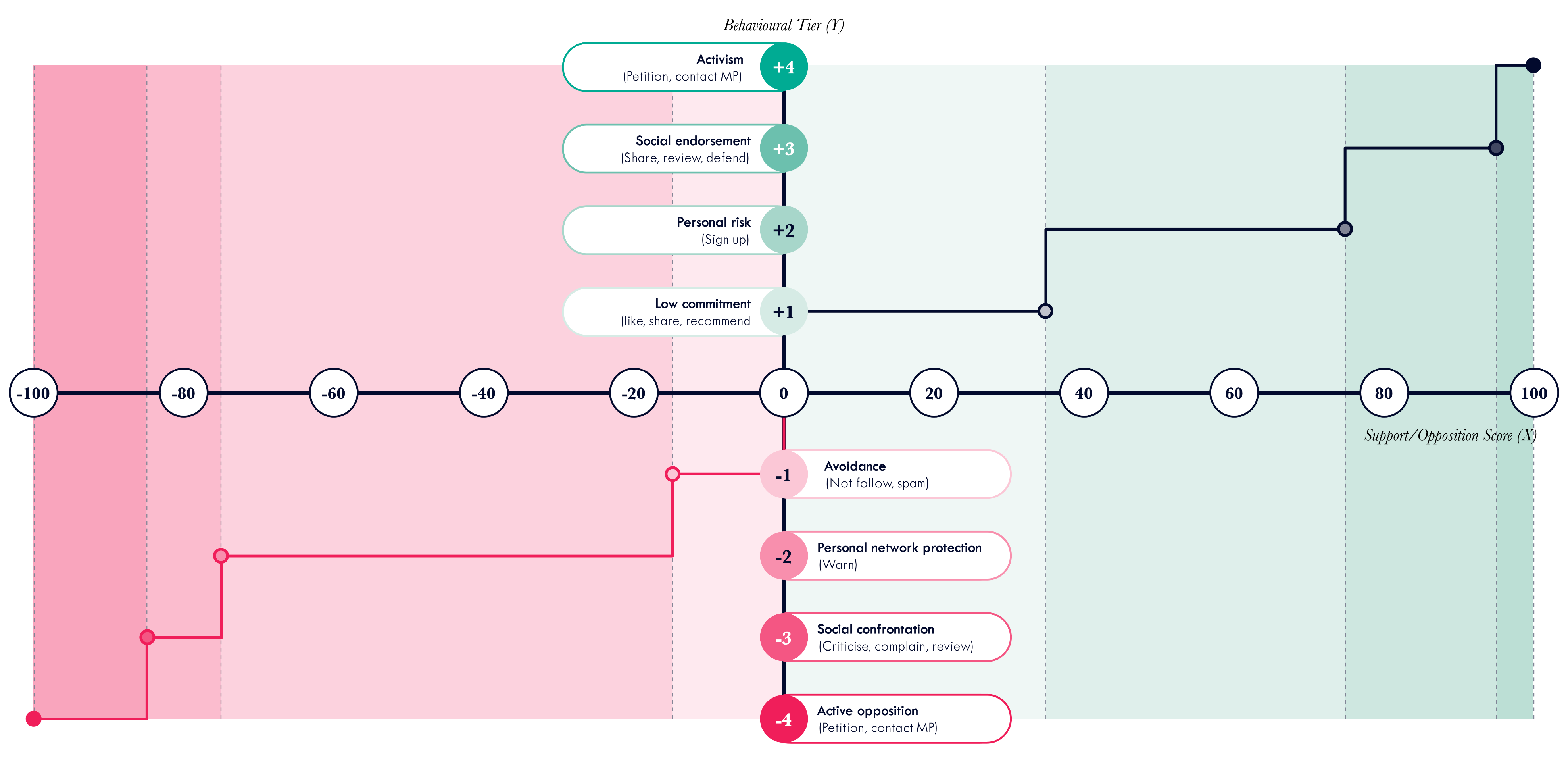
At almost any level of support, from neutral upwards, people are willing to take low-commitment actions such as liking social content.
The next stage is more meaningful. At support levels around the low 20s to 30s, people become more willing to take actions that involve some personal risk, most notably sharing data. This is the threshold at which people become willing to enter a two-way relationship, implying a degree of trust.
Public actions such as sharing content, writing a positive review, or defending a company require a notably higher level of support. These behaviours see a step up once people move into the +70 support range. Even at these very high levels of declared support, only just more than half are willing to make a public endorsement. It takes a lot before people are willing to put their own reputation on the line in public.
Signing a petition or contacting an MP on behalf of a company requires the strongest support of all. These are high-effort actions. Only one-quarter to one-third of people in the 90+ support bracket are willing to take them. That’s a useful reminder that a relatively small percentage willing to take activist action may still represent a very significant success.
Opposition follows broadly the same steps in reverse.
Opposition begins early with avoidance. The moment people feel neutral to mildly negative, many are already willing to unfollow a company, ignore its content, or mark its communication as spam.
At -10 to -20 people become willing to warn friends and family. This is one of the most commercially important findings in the research. There is a long zone in which private negative sentiment is active, but public signals remain muted. Businesses therefore risk underestimating opposition building around them if they are only looking at visible signals online or in the media.
Criticising a company publicly, complaining, or posting a negative review generally requires much stronger opposition. Active opposition, such as signing a petition or contacting an MP, sits at the far end of the spectrum, at minus 70 and below. A public backlash is often the end point of a process, not the beginning of one.
Elites move sooner and less predictably
The most striking additional finding is that elite audiences move sooner into active and public support or opposition than the general public. This matters because it is these stakeholders who have the most influence over media coverage, policy, regulation and reputation.
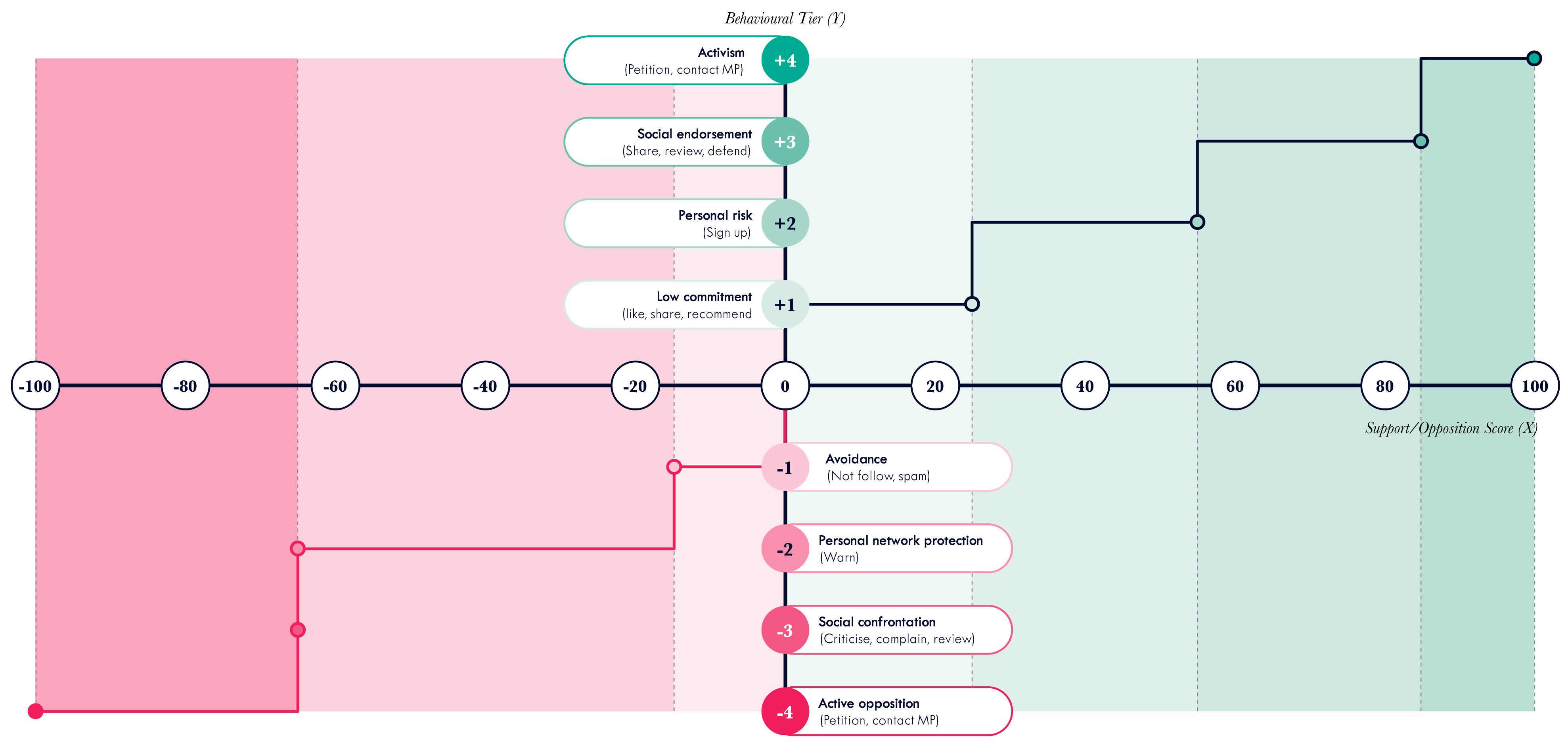
The broad hierarchy still holds. But the thresholds seem lower and less predictable. Elite audiences appear more willing to take activist steps at comparatively low levels of support or opposition. They are much more prepared to confront or escalate sooner than the national sample, especially on the negative side.
What this tell us about support overall
First, support starts with delivery: good products, good service, good value and reliability.
Second, the factors that build support are not always the same factors that create opposition. Active opposition is more likely when companies are perceived to behave unfairly. This is especially true for elite audiences.
Third, support moves in thresholds. Have you earned enough support for trusted data sharing, for public advocacy, or for active mobilisation? Equally, is opposition in the silent zone of withdrawal and private warning, or has it reached the point where people are prepared to organise against you?
Fourth, elite audiences move to action sooner. These audiences deserve special attention not just because of the power they wield, but because they might be the canary in the coal mine: an early warning that concern may be turning into visible opposition.
Understanding drags, drivers, and thresholds for support matters. Unlike sentiment analysis, it starts to show not just how people feel about you, but what they may do next without your intervention. Running the research at a sector or company level can tell you where there are opportunities to turn support into action or to stop a lack of support turning into active opposition.
That is why corporate affairs needs to move beyond measuring sentiment. The real question is not whether people feel warmly towards you. It is what they are prepared to do as a result.
Will they share data? Recommend you? Defend you? Contact an MP for you? Or are they privately warning others to stay away?
That is the difference between being liked and being supported. And in moments of pressure, only one of those is much use.
Next week, I’ll look at what we found when we ran the research at a sector level. Which sectors do people support, what’s driving that support or opposition, and how can you build support?


