




One of the most superficially attractive arguments in corporate affairs is: “Don’t put your head above the parapet.”
For most organisations, it is bad advice.
The XFT Index tracks the 20 members of the FTSE 100 that are highly profitable but most rarely mentioned in the Financial Times. Its premise is that "boring" businesses generally provide stronger returns than those constantly in the news.
In a volatile world, a low-profile strategy may work for a select few. But in my view, the index tells us more about the companies than their communications. They tend to be less regulated, less politically contentious and less vulnerable to takeover speculation.
The problem is that the instinct to avoid attention can take hold in companies where silence is obviously a poor strategy.
Keeping your head down does not only reduce attention. It also reduces the relationships, trust and visible backing you can draw on when you need them.
Those who favour this approach miss three things about how support works.
Three things people get wrong on support
First, support is competitive. Politicians, the media, investors or campaigners do not have the time or attention to support every request they receive. Many companies are looking at Andy Burnham’s new government as a moment of opportunity to make their case. But the bandwidth of the new government is limited. Your idea is competing with hundreds of others. Ideas are more likely to cut through when they are proposed by people decision-makers know and trust.
Second, lending support is risky. If support proves to have been misplaced, perhaps by a broken promise, then the person giving it feels embarrassed or undermined. This is even more pronounced for public figures and decision-makers, whose own credibility is on the line. Visible support is therefore a very high bar. Investing in the relationships that build trust is an essential precursor to people taking supportive action. It is no good to engage only when you have something to ask for.
Third, support builds on itself. It is easier to support a business that is already backed. Being part of the herd provides safety. “Nobody ever got fired for buying IBM” worked for a reason. It is harder to back a business not widely supported. Riskier still to stand alone and support one taking criticism. The reverse is also true. Businesses with weak support – or facing public opposition - are easier to attack, regulate or tax because doing so carries a reputational or political upside.
For all these reasons, corporate affairs leaders should invest in building support and understand the level of support or opposition they enjoy.
Who enjoys support today?
So who enjoys support today? Last week I mentioned the new research that I have been involved in from 5654 & Company. As well as identifying the overall drivers of support, we looked at how different sectors compared to each other.
We asked people whether they supported or opposed different sectors to give us a net support score - similar to net sentiment scores you will have seen before. But we asked something different too. We asked what action people would be willing to take to support the sector. By weighting this to reflect the effort and personal risk involved in each action, we were able to produce a support action score. This ranks how much people are willing to stick their head above the parapet for you.
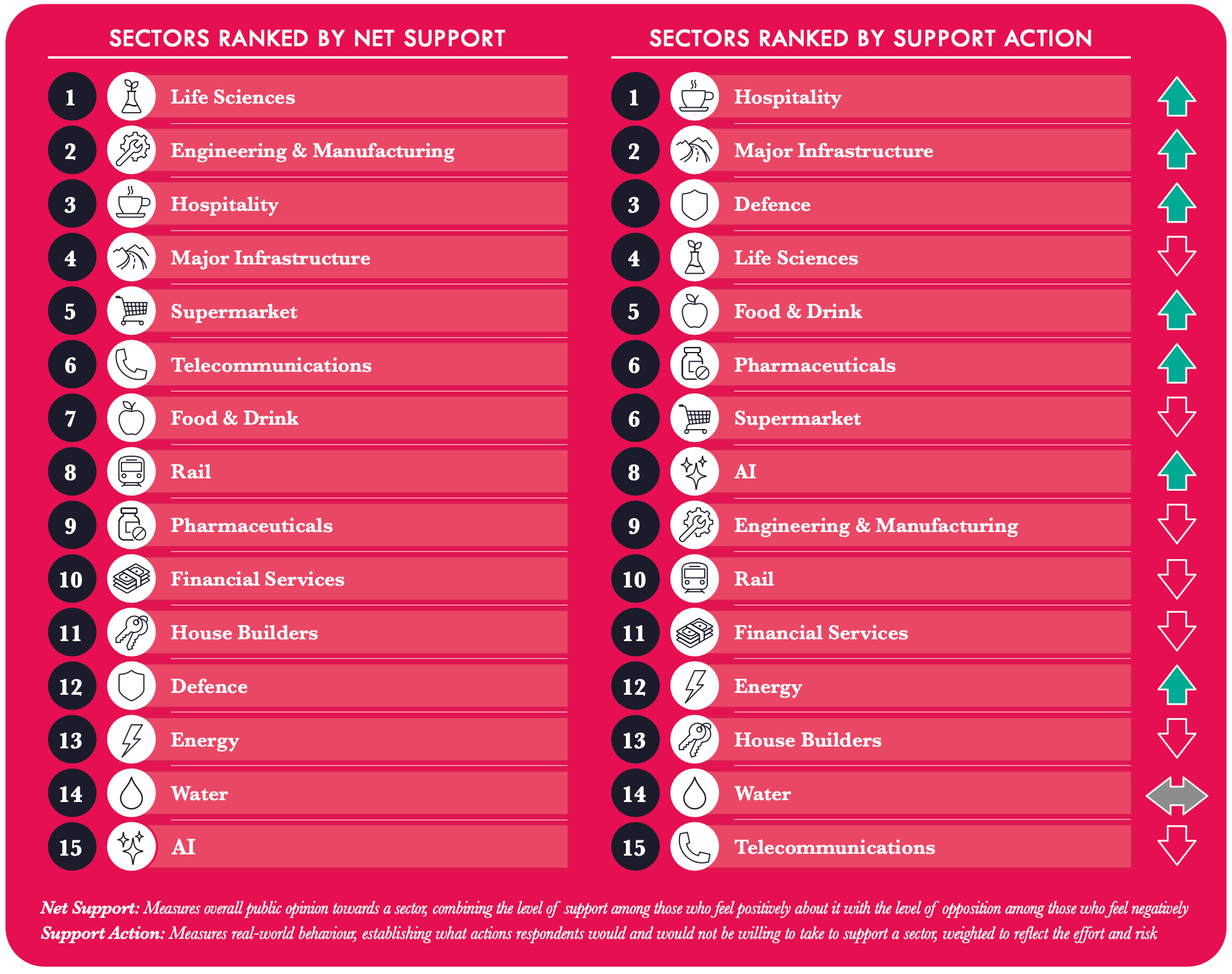
What emerges is a more sophisticated understanding of support. It shows that some industries enjoy widespread goodwill but struggle to mobilise that into meaningful action.
Life sciences is a good example: top of the chart for overall net sentiment, but fourth when people are asked what action they would take to support the sector. Telecommunications moves from a relatively high sixth for overall support, to bottom of the table for support action.
Defence displays the opposite pattern. Its net support is relatively low, but those who do support it are willing and motivated to act.
By asking people to describe reasons for support in their own words, we were able to understand not just how support varies, but why. For example, AI has one of the lowest net support scores of any industry measured. But AI’s supporters are among the strongest and most willing to take action - even highly visible or high-effort actions. The people who appear to be driving this are younger, more urban professionals who are optimistic about innovation and see AI as a driver of productivity and future growth.
How do you build support if you don’t have it today?
Of course, knowing what support you enjoy is only half of the challenge. More important still is understanding how to maintain it or build it effectively.
I think that involves answering three questions.
First, whose support matters?
Which audiences matter most depends on the outcomes you are trying to achieve and the context you are operating in. Defining the right audiences (both the primary decision-makers and the people or institutions that influence them) makes it clear whose support you need to win.
Second, what is driving their support or blocking it?
Winning support is rarely about shouting louder. Awareness and understanding are sometimes the issue, but more often action is blocked by perceptions of risk or effort, or because people don’t have the time or inclination to support you.
If you can clearly identify the barriers that are preventing action, you can design a strategy that deals with the real problem rather than the superficial one.
A good way of doing this is by applying a behaviour change framework such as COM-B to test whether the barrier to support relates to a decision-maker’s capability, opportunity or motivation to support you. This helps identify how you can make it easier for someone to take the action you want. Are you targeting the real decision-maker? Is your ask clear enough? Does it deliver on the things they care about? Be clear about what you think will shift their support and why.
Third, what would move them to action?
A good narrative can help turn your strategy into an argument your audience can understand and support. It should reflect the pressures and priorities shaping their world, define the problem in terms they recognise, explain your credible role in solving it, and make clear why the outcome will be better if they support you.
You will then usually face some difficult choices about where to focus time, budget and activity. This can feel uncomfortable because it forces trade-offs. But in a world of limited attention, identifying and prioritising the interventions most likely to strengthen support or reduce opposition is essential.
That may mean stronger evidence, mobilising more vocal allies, or simply better timing. The aim is to make the things that drive your support more visible, while systematically removing the barriers that prevent people acting in your favour today.
The result should be a practical plan for where to focus, what to fix, and how to communicate.
Conclusion
The safest corporate strategy might appear to be keeping your head down. But it is a limited and short-term strategy. When the rains come, you may find there is no-one willing to lend an umbrella. Support is hard to build from scratch in a crisis.
AI search makes silence more dangerous still. If you do not explain your business clearly, AI systems will construct their answers from whatever sources are available, including critics and outdated coverage. Unlike journalists, they will not come back to ask for your side of the story. That makes the old tactic of publishing nothing on difficult issues increasingly untenable.
And the cost of silence is not only defensive. Latent or unused support is like cash sitting in a current account. It still has value, but less than if you put it to work. Using it well can help drive outcomes while demonstrating your value still further.
The real task of corporate affairs teams is to build enough support that, when the criticism comes or the decision really matters, others are willing to put their heads above the parapet for you.


